How to Get SIM Card in Nepal: The Ultimate Guide You Can’t Miss!
Getting a SIM card in Nepal is a simple and quick process for both tourists and locals.
The first step is to choose a SIM provider like Ncell, NTC, or Smart Cell.
You can find authorized SIM card shops or official counters at places like Kathmandu and Pokhara.
If you arrive at Tribhuvan International Airport, you will find booths where the staff will help you fill out a registration form.
You’ll need to show your documents, including a passport photo and a copy of passport or visa.
Once everything is ready, the staff will activate your SIM. The process is quick, much faster than a Kathmandu traffic jam clearing up!
If you missed the chance at the airport, don’t worry. You can also go to shops in Thamel, a popular area for tourists.
SIM cards in Thamel are easy to find, and you can pick a datapack or a plan that suits your needs.
Prices usually start from Rs. 200. You can also pay using Nepali digital wallets like eSewa or Khalti.
For locals and foreigners, both prepaid and data packages are available.
If you face any issues with the SIM, there is customer support through apps or at service centers.
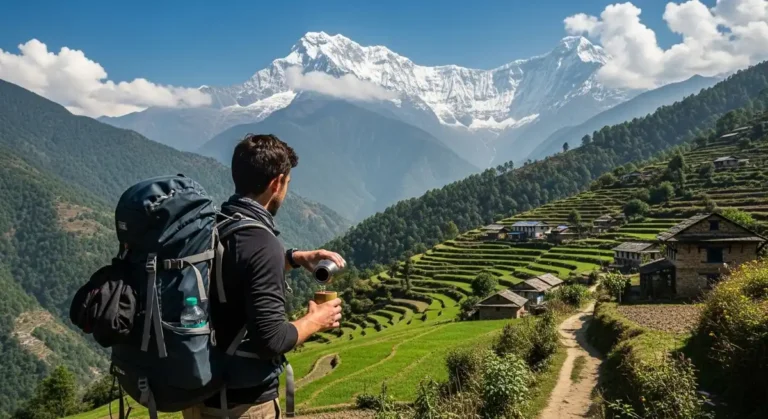
Always make sure to check coverage and package rates before you choose, especially if you’re planning to visit remote regions or go trekking in areas like the Himalayas, where network coverage can be tricky.
Why You Need a SIM Card in Nepal?
If you’re visiting Nepal, getting a SIM card is a smart choice. It helps with affordable communication and data.
A local SIM is cheaper than using international roaming, so you can make calls, send texts, and use internet for browsing or checking social media.
You’ll need data for important tasks like navigation and booking services.
For example, you can use Google Maps to find your way or ride-sharing apps like Pathao or InDrive to book rides.
These are especially helpful in remote areas where signs are often scarce.
With a SIM card, you can stay connected with family and friends. You’ll be able to share your experiences and stay in touch.
It’s also helpful in emergency situations. Having a local number is critical for contacting local services or finding information in case something goes wrong.
Plus, if you’re a tourist, getting a new SIM card when you arrive can help you save money on international communication.
A SIM card lets you take advantage of online services and transactions, making your trip more practical and less stressful.
Make sure you pick a SIM card with good coverage if you’re planning to go trekking or hiking in different parts of the country.
This will ensure you stay connected wherever you are.
Major Mobile Providers in Nepal
In Nepal, there are several important mobile providers. The biggest players are Ncell and Nepal Telecom (NTC), both offering a range of services to locals and tourists.
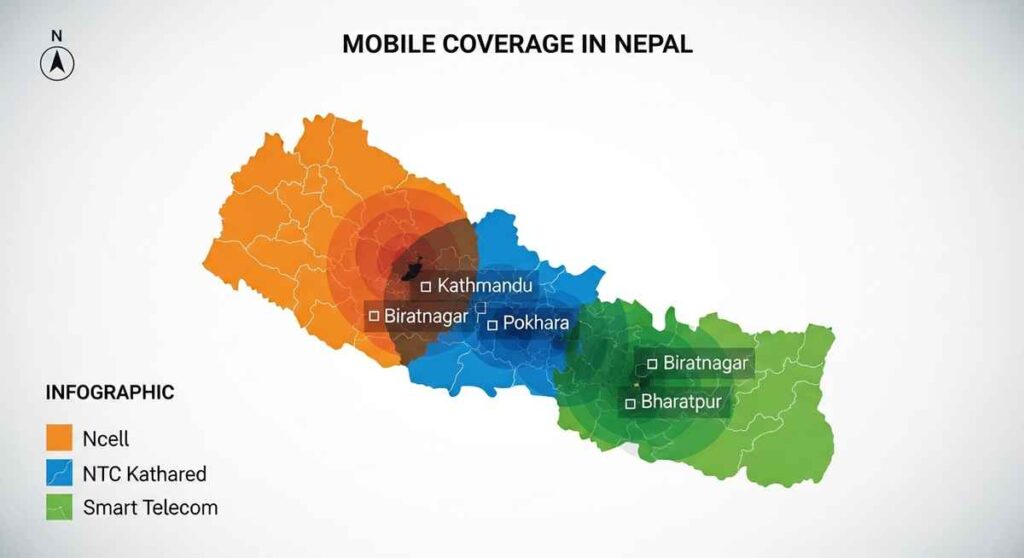
Smart Telecom is also emerging as a smaller but notable provider.
Each has its own strengths, especially when it comes to coverage, internet speeds, and the services they offer.
1. Ncell: The Private Provider
Ncell is the largest private operator in Nepal. It provides fast internet speeds with 3G, 4G, and some areas having 5G services.
The company is most popular in urban centers like Kathmandu and Pokhara, where it offers reliable voice calls, SMS, and data plans.
Ncell offers prepaid and postpaid SIM cards, which are ideal for both locals and tourists.
It is a tourist-friendly provider due to its affordable plans and great customer service.
However, its coverage may not be as strong in rural areas or remote regions, like the Annapurna Base Camp or Everest Base Camp.
2. Nepal Telecom (NTC): The State-Owned Provider
Nepal Telecom (NTC) is the oldest and largest state-owned telecom provider in Nepal.
NTC’s network is extensive, offering strong coverage in both urban areas and remote regions, including popular trekking routes.
NTC offers 3G, 4G LTE, and fiber internet (FTTH) services, making it a reliable option for those traveling to places like Everest Base Camp or Annapurna Base Camp.
NTC also provides international roaming and prepaid SIM cards, which can be used for both data packages and voice calls.
NTC’s services are especially reliable in rural areas and mountainous regions where other providers might have weak signals.
3. Smart Telecom: The Emerging Provider
Smart Telecom, also known as Smart Cell, is a newer and smaller provider in Nepal.
It is not as widely known as Ncell or NTC, but it offers competitive data services and is popular among those who want a budget-friendly option.
Smart Telecom provides prepaid SIM cards and data-only packs in urban areas.
The company has started expanding its network, especially in growing towns, but it doesn’t have the same level of coverage as Ncell or NTC in remote areas.
Nonetheless, it is still a good choice for tourists who are mainly staying in major cities and need data for travel apps and communication.
4. Services and Coverage Comparison
When comparing coverage, Ncell excels in urban centers like Kathmandu and Pokhara, providing fast internet speeds with 4G LTE.
On the other hand, NTC offers better coverage in rural areas, remote regions, and trekking regions like Annapurna Base Camp and Everest Base Camp, where you can rely on its services for voice calls, SMS, and data management.
Smart Telecom is great for those on a budget who primarily need data services in the cities, though its network in remote areas is still growing.
5. Prepaid and Postpaid SIM Cards
All three providers offer prepaid SIM cards, which are the most popular option for tourists.
They also provide postpaid SIM cards for long-term residents. NTC offers affordable plans that are ideal for those traveling in Nepal and need to stay connected while trekking or exploring remote regions.
Ncell, with its high-speed internet, is better for those staying in urban areas.
Smart Telecom offers affordable prepaid SIM cards, with plans that are especially popular for data-only packs in major cities.
Types of SIM Cards in Nepal
In Nepal, there are three main types of SIM cards: prepaid, postpaid, Tourist SIM Cards, data-only, and eSIM Cards.
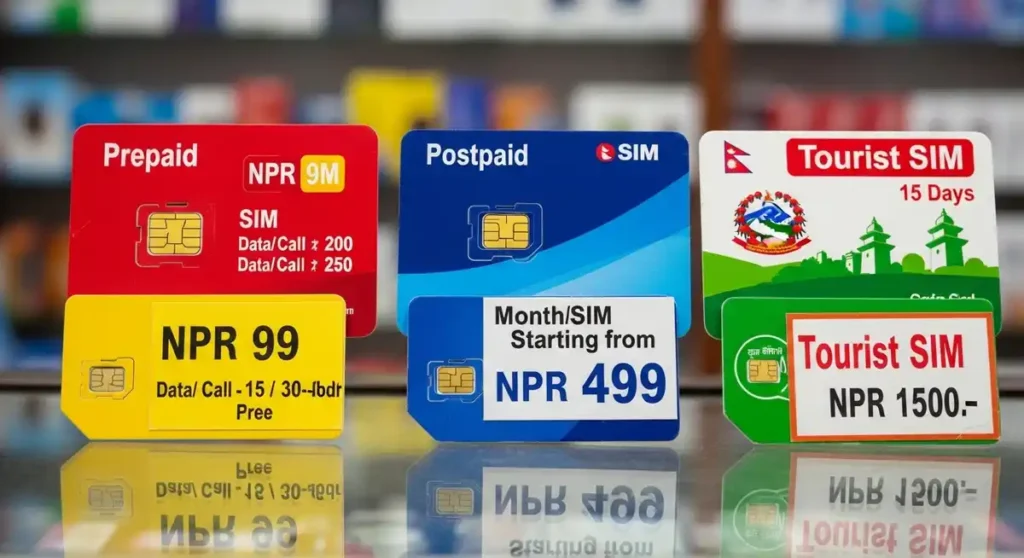
1. Prepaid SIM Cards
In Nepal, the prepaid SIM is very popular. You pay in advance and use it for talk time, SMS, and data.
You can recharge it whenever you run out of balance, using mobile wallets like eSewa and Kalti or recharge cards.
SIM providers like Ncell, Nepal Telecom (NTC), and Smart Telecom offer various plans with options for daily, weekly, or monthly data and voice packs.
2. Postpaid SIM Cards
The postpaid SIM is designed for people who prefer to pay at the end of the month.
It’s often used by long-term residents, business users, and government offices.
You will receive a monthly bill based on the data, talk time, and SMS you use. To get this SIM, you need a local bank account and a permanent address in Nepal.
3. Tourist SIM Cards
A tourist SIM is made specifically for foreign visitors. It comes with starter packs, which may include free talk time and a bonus balance.
These SIM cards are valid for a limited time, usually 15-30 days, and can be recharged if necessary.
They are available at SIM centers and popular shops around Nepal.
4. Data-Only SIM Cards
For those who need only internet access, a data-only SIM is a great option.
This SIM is ideal for remote work, streaming, or using mobile internet on smartphones, tablets, and routers.
It does not include voice calls or SMS services, so it is perfect for data-heavy users who don’t need traditional phone services. These SIMs often come with high-speed 4G packages.
5. eSIM Cards
An eSIM is a digital SIM that works on compatible devices. You don’t need a physical SIM card.
Instead, you can download it to your device. Both Ncell and NTC offer eSIM options, providing the same services as a physical SIM.
Step-by-Step Guide to Getting a SIM Card in Nepal
Step 1: Choose Your Mobile Provider
Choosing the right mobile provider in Nepal is crucial for staying connected during your travels. Here are some key points to consider when selecting the best provider for your needs.
1. Ncell – Best for Fast Internet in Cities
- Ncell offers excellent data speeds and coverage in urban areas.
- You can enjoy voice plans, SMS, and high-speed 4G LTE services.
- Ideal for tourists who need quick access to internet and mobile apps.
- However, if you’re trekking in remote regions like Everest Base Camp, you might find the signal weak in the cold.
2. Nepal Telecom (NTC) – Best for Reliable Coverage in Rural Areas
- NTC is a state-owned company with strong network coverage in rural and remote areas.
- Great for trekkers heading to locations like Annapurna Base Camp or Everest Base Camp, where network reliability is essential.
- Offers voice calls, landline, fiber internet, WiMAX, and more.
- Known for providing reliable services even in remote villages and high-altitude locations.
3. Smart Cell – Budget-Friendly Option for Urban Areas
- Smart Cell is perfect for those looking for affordable data and voice plans.
- While its coverage in urban areas is good, it is still expanding to more districts.
- Great for budget-friendly mobile users who mostly stay in the city or areas where Smart Cell operates.
- Not recommended for trekkers or those who need wide coverage in remote locations.
4. eSIM – Convenient Option for the Tech-Savvy Traveler
- Both Ncell and NTC offer eSIM options for those with compatible phones.
- Perfect for travelers who want to avoid changing physical SIM cards.
- eSIMs are easy to set up, making it a convenient option for foreign travelers.
5. Where to Buy Your SIM Card
- You can easily buy a SIM card at the airport or from various retail locations in Nepal.
- Most SIM cards are available for prepaid or postpaid plans, and you can choose based on your stay duration and needs.
By considering these factors, you can select the mobile provider that best fits your travel plans and stay in Nepal. Whether you’re looking for fast internet or reliable coverage in remote areas, there’s a provider that fits your needs.
Step 2: Documents required for SIM card in Nepal
To get a SIM card in Nepal, you will need the following documents:
- Valid passport: The most important document for identification.
- Copy of your passport: A visa page or entry stamp is required.
- Passport-sized photo: You must bring one or two for SIM registration. If you don’t have one, SIM shops can take and print them for around NPR 50-60.
- Local contact number: This may include your hotel or accommodation details.
- Photocopies of your passport and visa: These will help with SIM activation.
- National ID or driving license: Some telecom operators may ask for additional IDs.
- Mobile Device IMEI Registration: Necessary for new phones.
Make sure to bring the original documents for verification.
Step 3: Where to Buy a SIM Card
When you arrive in Nepal, getting a SIM card is one of the first things you’ll need to do.
It’s easy to find places to buy a SIM card, whether you’re at the airport or in tourist areas.
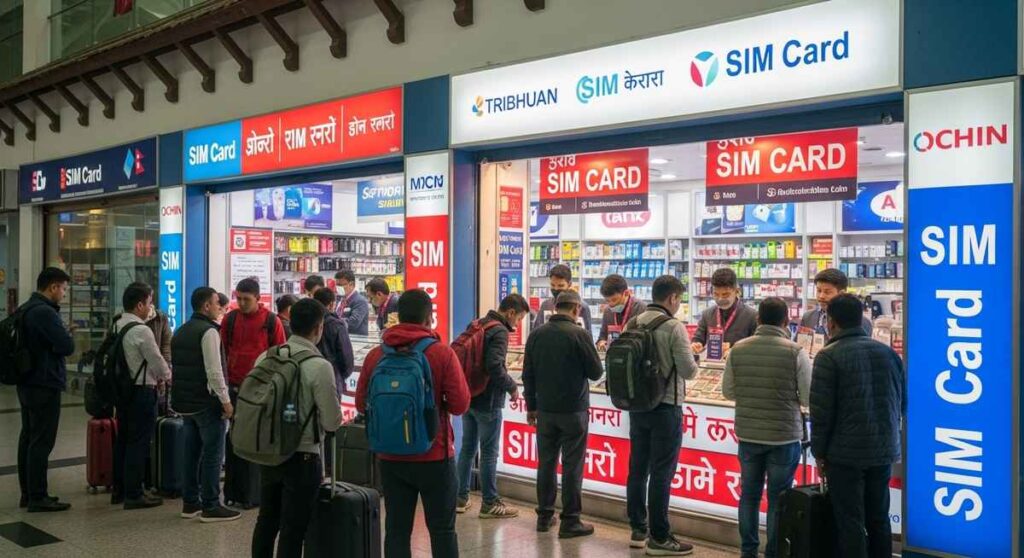
Here’s a guide to help you know where to go.
Kathmandu Airport (Tribhuvan International Airport)
One of the easiest places to buy a SIM card is right after your arrival at Tribhuvan International Airport in Kathmandu.
You will find counters for Ncell and Nepal Telecom (NTC) in the airport. These counters are quick and efficient, making it simple to get a SIM card as soon as you land.
Official Mobile Provider Stores
If you prefer to buy your SIM card outside the airport, you can visit official stores of Ncell, NTC, and Smart Telecom in cities like Kathmandu, Pokhara, and Biratnagar.
These stores offer reliable service, and the staff can help you with SIM registration and activation. You can also choose from a variety of packages for data, internet, and roaming.
Local Shops in Tourist Areas
For a more convenient option, head to tourist areas like Thamel in Kathmandu. You will find many mobile shops here that sell SIM cards.
These local shops often have Ncell and NTC SIMs, and you can easily register and activate your card. Just make sure the shop is authorized to avoid any issues later.
Authorized Dealers in Shopping Centers
In shopping centers and markets across Kathmandu, Pokhara, and other towns, you will find authorized mobile dealers selling SIM cards.
These dealers are approved by the Telecommunications Authority and offer both physical SIMs and e-SIMs. They will also assist you with SIM registration and activation.
Local Phone Shops and Kiosks
If you are traveling to smaller towns or villages, you can buy a SIM card from local phone shops or kiosks.
Be sure to buy from legitimate vendors and ask for a receipt to avoid any problems. These shops can also help you with top-up cards and offer SIM registration services.
Step 4: Complete the Registration Process
To register a SIM card in Nepal, you need to visit one of the shops or centers. The first thing you’ll do is fill out a form.
This form asks for your full name, passport number, nationality, local address in Nepal, like your hotel, and sometimes your contact number or email.
You’ll also need to sign at the end of the form to confirm that the details are correct and to agree to the provider’s terms.
If you face any problem, the shopkeeper or staff at the counter will help you complete the form.
They will even fill it out for you, and you just need to check the details and sign it.
This registration is part of the identity verification process required by the Nepalese government to stop misuse.
After that, the form is sent to the telecom provider for activation.
You also need to provide important documents like a passport-sized photo, proof of address (such as a hotel booking), and sometimes more photos.
The submission is quick, and the activation instructions will help you set up your new SIM card.
Step 5: Activate Your SIM Card
How to Activate Your SIM Card in Nepal?
To activate your SIM card in Nepal, first, you need to insert it into your phone.
Make sure your phone is unlocked so it can work with any network, not just those from your country.
After inserting the SIM, restart your device. Wait for a few minutes for it to find the provider’s network like NTC, Ncell, or Smartcell.
You should see a signal bar on the screen to show it’s connected.
If the SIM doesn’t activate instantly, you may need a manual activation. This is where the shopkeeper can help.
Normally, they will activate it for you during the registration process. But if that doesn’t work, you can use the mobile app from your SIM provider.
Just follow the instructions or ask the seller for help. This process is quick and will be completed in just a few minutes.
If it still doesn’t work, check your settings. Ensure mobile data is on and set to 2G, 3G, or 4G (Auto).
You can also try restarting the SIM in a different phone. If it’s still not working, contact customer support by dialing the help numbers: Ncell *9005# or 9005, NTC 1498, or Smart Cell 4242.
Buying and Testing Your SIM Card in Nepal
When you buy your SIM card in Nepal, you can get it at the airport, an official store, or an authorized shop.
To buy a SIM, bring your passport, a passport-sized photo, and sometimes a visa. You’ll also need to fill out a small form with your details.
After registration, the store staff will help you activate your SIM. Before you leave, test it by making a call or using data.
You can also recharge your SIM if needed, using packages available in the shop or online.
The process is affordable, convenient, and flexible. It’s easy to stay connected with loved ones or navigate your trip in Nepal.
You can also top-up your balance as needed to stay in touch.
SIM Card Costs in Nepal: What to Expect
When you arrive in Nepal, you can easily buy a prepaid SIM card. The cost is usually very low. It can range from 100 NPR to 200 NPR, which is less than $2.
This price often includes a small amount of credit for calls or data. For example, you might get 5 GB of data for about 500 NPR or around $4. It is a good deal for most people.
SIM Card Options and Pricing
There are three main SIM card operators in Nepal: Nepal Telecom (NTC), Ncell, and Smart Telecom.
The cost for each of them is similar. For NTC, you might pay 100-150 NPR, while Ncell and Smart Telecom may cost about 100 NPR.
The price can also change depending on the location and sellers.
- Data packages range from 100 NPR to 500 NPR. These plans are affordable, and you can get small bundles or larger combo plans.
- On average, you might spend 500 NPR to 1500 NPR for a good amount of data and calling minutes.
Mobile Data Plans and Packages in Nepal
In Nepal, mobile users have plenty of choices when it comes to data plans and packages from major providers like Ncell and Nepal Telecom (NTC).
These providers offer a variety of options that cater to different needs, whether you’re a tourist, a local, or someone who uses a lot of data or prefers voice calls.
Ncell Data Plans
Ncell provides several recurring plans under their Sadhai-on category, which combine data, voice, and SMS.
For instance, the 8GB plan costs Rs. 399 for 28 days, including 4GB social media data.
If you need more data, the 13GB plan is available for Rs. 499, also with 4GB social media included.
They also offer unlimited calls in their larger packages. You can get 30GB for Rs. 799, 50GB for Rs. 999, or 100GB for Rs. 1499, with unlimited calls included in each plan.
For visitors, Ncell has Tourist SIM Plans, offering unlimited data and calls, with options ranging from Rs. 595 to Rs. 1995 depending on the plan.
Nepal Telecom (NTC) Data Plans
Nepal Telecom (NTC) offers a wide range of data plans, from small to large volume packs.
They have All Time Data Packs, such as 12GB for Rs. 199, 20GB for Rs. 399, and 30GB for Rs. 499.
For more intensive users, there is a 100GB plan available for Rs. 999 for 28 days.
NTC also provides smaller options, like 600MB for 1 day or 700MB per day for 28 days.
They have a special 15 Mbps speed pack that gives you 15GB/day, but the speed is reduced to 1Mbps once you’ve used all the data. This pack costs Rs. 89.
Other Providers
In addition to Ncell and NTC, there are other options like Nomad eSIM and Yesim for eSIMs, which are great for travelers looking for flexibility without changing their physical SIM.
Both Ncell and NTC also offer eSIM options for those who prefer digital SIM cards.
Wraptel is another option that provides prepaid SIM cards for use in Nepal and over 150 countries.
Additional Data and Call Packages
If you need more data or call minutes, both Ncell and NTC offer add-on packages.
Call packages start at 50 NPR and can go up to 300 NPR, depending on the number of minutes you need.
For data, you can get 5GB for 500 NPR, and larger packages, like 10GB, cost between 800 NPR and 1,500 NPR.
These plans are much cheaper than using roaming services from your home country.
Flexible Data Plans for Every Need
The data packages are designed to suit different types of users.
For example, small packages are perfect if you only need to check emails or use maps, starting at 100 NPR for 1GB.
If you’re someone who uses the internet for casual browsing, messaging, or posting on social media, the medium packages offering 5GB for 500 NPR are ideal.
If you’re into streaming videos or working online, you’ll need large packages, such as 10GB for 1,000 NPR, or even more.
With these affordable data plans from Ncell, NTC, and other providers, you can stay connected without worrying about high costs.
Whether you are using a prepaid or postpaid SIM card, there’s always an option for everyone, and it’s easy to buy these plans through simple dialing codes like 1415# for NTC or 123# for Ncell.
Where to Use Your SIM Card in Nepal?
When traveling to Nepal, having the right SIM card can help you stay connected, whether you’re exploring busy cities or trekking through the mountains.
Here’s what you need to know about using a local SIM in Nepal.
Internet While Trekking
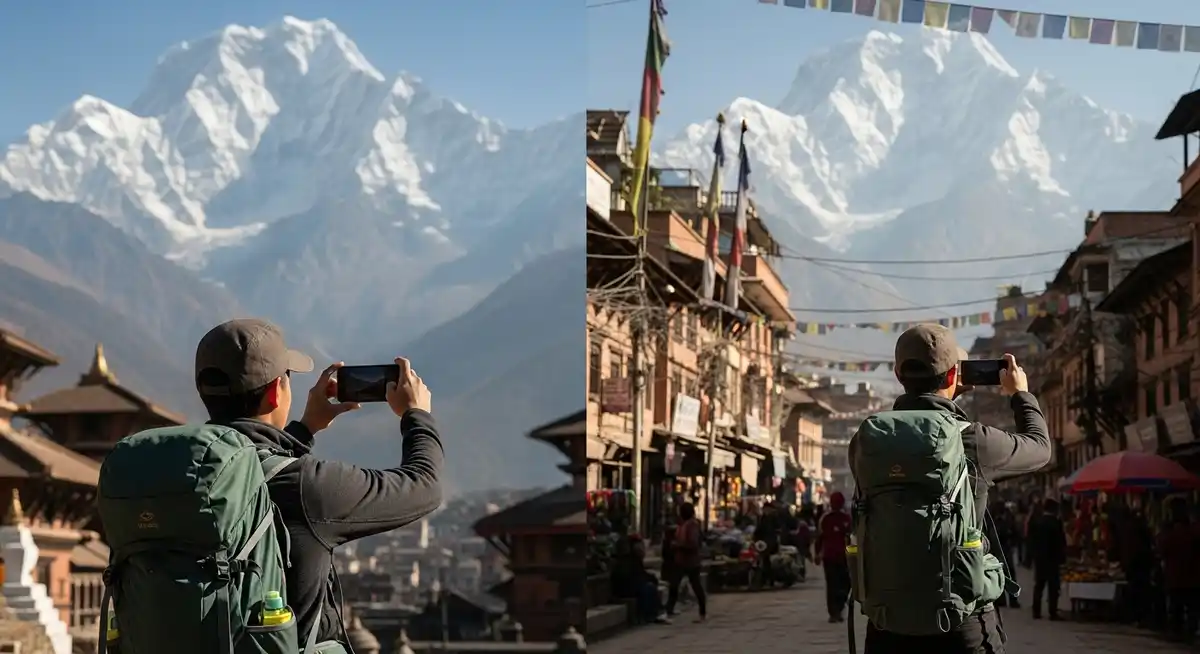
In Nepal, you can easily get a local SIM card for your phone. It works well in populated areas like Kathmandu and Pokhara.
These are the main tourist hubs. If you’re going trekking, you’ll find it useful in places like Everest Base Camp and Annapurna Base Camp.
Some places might have spotty coverage, especially at high altitudes, so keep that in mind.
You should download offline maps for navigation when trekking in mountainous trekking regions.
Mobile Network Coverage Comparison
You can choose between two options for your SIM card: Ncell and Nepal Telecom (NTC). Ncell is best for fast internet speeds in urban centers and cities.
On the other hand, NTC gives better coverage in rural and remote areas. If you’re trekking in mountain areas, NTC is the better choice as it has stronger coverage.
To get a SIM card, you will need a passport photo, a copy of your passport, and a visa.
Don’t forget to make sure your phone is unlocked to work with Nepal networks.
NTC is expanding its 4G coverage and plans to reach over 98% of local levels by October 2025.
However, it might not have the consistent 4G speeds that Ncell offers in urban areas.
Ncell is ideal for people who are mainly staying in cities like Kathmandu and Pokhara because of its competitive data packages and fast 4G speeds.
Recharging Your SIM Card in Nepal
In Nepal, there are several ways to recharge your SIM card. You can use scratch cards, online methods, or do a balance transfer from local shops and centers.
For example, with a recharge card, dial the code and enter the PIN number.
For Ncell, you can dial 122PIN# or call 90012 and follow the voice prompts. You can also send the PIN by text to 90012.
Another option is online recharge. You can use digital wallets like eSewa, Khalti, or IME Pay to recharge your phone.
Ncell and Nepal Telecom (NTC) both offer online recharge services. You can use a debit card, credit card, or e-wallet to pay for the recharge.
You can also visit the Ncell Recharge Portal or use the Ncell mobile app.
Some international services like Nepalekart allow you to recharge from abroad as well, for example, from India using Indian banking methods.
For easier access, visit an authorized shop or retailer to buy recharge vouchers or initiate a balance transfer.
In many local shops, supermarkets, and even tea stalls, you can find recharge cards.
If you’re in a hurry, you can visit the provider’s store for recharge assistance.
They can help you with the PIN code, and you can pay with cash if needed.
Make sure to enter the correct mobile number when you recharge and check your balance by dialing the balance inquiry code or using the app.
Additionally, you can recharge using mobile banking or even through ATM services.
If you’re outside, you can use third-party apps for mobile top-ups.
Some banks also allow you to recharge your SIM card through their ATM machines.
Be sure to check the recharge validity and ensure your recharge method works.
Tips for Using Your SIM Card Efficiently in Nepal
Using Your SIM Card in Nepal
- Buy a Local SIM at the Airport: For convenience and good rates, get your SIM card as soon as you arrive at the airport.
- Choose Between NTC and Ncell: If you’re heading to rural or mountainous areas, NTC offers better coverage. For the city, Ncell is a great option with fast internet.
- Test Your SIM: Before leaving the store, make sure to test your SIM to ensure it’s working properly.
- Carry Nepali Rupees: Many small shops in Nepal don’t accept cards, so carry Nepali rupees to make payments easier.
- Have Your Documents Ready: You’ll need your passport and other documents for SIM registration.
Managing Your Data and Costs
- Choose the Right Data Plan: Pick a data plan that suits your needs, whether it’s for browsing, streaming, or using apps.
- Monitor Your Data Usage: Keep an eye on your data usage to avoid exceeding your plan’s limit and getting extra charges.
- Use Wi-Fi Whenever Possible: Save on mobile data by using Wi-Fi at hotels, cafes, and other public places.
- Enable Data-Saving Settings: Set up data-saving features on your phone and apps to reduce data consumption.
- Check Your Balance Regularly: Use the USSD code provided by your provider to check your balance and keep track of your usage.
- Use WhatsApp for Communication: Stay connected with friends and family using WhatsApp, so you don’t need to change your number.
Topping Up and Extra Tips
- Top Up Easily: You can top up your balance using scratch cards available at stores, or use online services like eSewa and Khalti.
- Stay Safe with a VPN: To protect your privacy and access restricted content, use a VPN when online.
- Be Cautious of Fraud: Watch out for fraud calls and messages asking for personal information or money.
- Save Contacts in Your Phone: Keep your contacts in your phone’s memory, not on the SIM, so they aren’t lost when switching cards.
- Download Offline Maps: For navigation, download offline maps like Maps.me if you’re going to areas with no internet service.
Can You Use International SIM Cards in Nepal?
Yes, you can use an international SIM card in Nepal, but it might be expensive.
This is because of the high roaming charges. Sometimes, the coverage can also be poor in remote areas.
It’s better to get a local Nepali SIM card when you arrive. Local SIM cards are more cost-effective and offer better data plans.
If you choose to use an international SIM, make sure your home carrier has a roaming agreement with a Nepalese operator.
The costs for roaming data can be steep. Even with a roaming data package, it will likely be more expensive than buying a local SIM.
Some places, like when you’re trekking, might have no signal at all.
Many people prefer using a global or travel SIM because it works in several countries, including Nepal.
You should check if your phone supports the GDM network, as telecommunication in Nepal uses this.
If you plan to stay in Nepal for a longer time, getting a local SIM is a better and more affordable choice.
You can get prepaid plans with fixed calls, SMS, and data services.
How to Get Sim Card in Nepal Online?
You cannot buy a physical SIM card online for pickup in Nepal. However, you can easily get an eSIM from a third-party provider online.
If you want a physical SIM, you will need to do it in-person once you arrive in Nepal.
When you get there, you must visit an authorized store. There, you will have to fill out a form.
You will also need to show a copy of your passport, a passport-sized photo, and your local address, like a hotel booking.
Conclusion
Getting a SIM card in Nepal is an easy process. You can choose between many options to stay connected during your journey.
Whether you need data, voice calls, or both, there is a SIM card that fits your needs. You can buy it at airports, stores, or even online.
One of the best places to get it is the Tribhuvan International Airport, but you can also find local authorized stores.
There are several service providers in Nepal such as Ncell, Nepal Telecom, and Smart Cell. Choose the one that fits your preferences.
Make sure to consider the service, coverage, and price before buying. If you are traveling for a long time, you can go for a prepaid SIM card.
You can also use an international SIM card, but the roaming charges are high. If you prefer something digital, you can opt for an eSIM for Nepal travel.
A SIM card will help you stay in touch with your friends and family while trekking or touring in Nepal.
Frequently Asked Questions (FAQs)
How to Get a SIM Card in Nepal?
Getting a SIM card in Nepal is easy. You can buy one at the airport, tourist areas like Thamel, or official stores. Choose a provider like Ncell, NTC, or Smart Cell, and bring your passport, photo, and visa. The staff will help you register and activate the SIM.
What Documents Are Required for a SIM Card in Nepal?
To get a SIM card in Nepal, you need a valid passport, a passport-sized photo, a copy of your passport or visa, and your local address. Sometimes, you might need an additional ID or a mobile device IMEI registration.
What is the Cost of 1 GB of Data in Nepal?
The cost of 1 GB of data in Nepal is around 100 NPR to 500 NPR. The price depends on the provider and the type of data plan you choose. Smaller packages can cost less, while larger plans cost more.
What is the Price of an NTC SIM in Nepal?
An NTC SIM card in Nepal usually costs between 100 NPR and 150 NPR. Prices may vary depending on where you buy it and the type of plan you select.
Can Foreigners Get a SIM Card in Nepal?
Yes, foreigners can get a SIM card in Nepal. You will need to show your passport, a photo, and sometimes a visa. Tourist SIM cards are available at the airport and other authorized locations.
How Much Does a SIM Card Cost in Nepal?
SIM cards in Nepal are affordable. They typically cost between 100 NPR and 200 NPR. The price often includes some initial credit for calls or data.
Which SIM Card is Best in Nepal for Tourists?
For tourists, Ncell is a great option for fast internet in cities. If you’re trekking in remote areas, NTC provides better coverage in rural and mountainous regions.
How Do I Activate My SIM Card in Nepal?
To activate your SIM card in Nepal, insert it into your phone and restart it. The SIM should activate automatically. If not, ask the shopkeeper for help or follow activation instructions provided by the provider.
Can I Use My International Phone with a Nepalese SIM Card?
Yes, you can use your international phone with a Nepalese SIM card. Make sure your phone is unlocked to work with any network in Nepal.
How Long is the Tourist SIM Card Valid in Nepal?
A tourist SIM card in Nepal is typically valid for 15 to 30 days. You can recharge it if needed to extend its validity.
Disclaimer
This content is provided by traveldrizzle.com for informational purposes only. Always verify with your mobile service provider before purchasing a SIM card.